
http://www.youtube.com/watch?v=mOvpV0CuEdc&feature=PlayList&p=066688BF380A8D4A&playnext_from=PL&playnext=1&index=22
Global Forums > General > beautiful visual explanation of pythagoras' theorem

Only members can see names and photos
beautiful visual explanation of pythagoras' theorem
Apr 6, 2010 @ 23:02
The text you are quoting:
http://www.youtube.com/watch?v=mOvpV0CuEdc&feature=PlayList&p=066688BF380A8D4A&playnext_from=PL&playnext=1&index=22
manics1984Apr 6, 2010 @ 23:02
Your Reply:



Only members can see names and photos
Re: beautiful visual explanation of pythagoras' theorem
Post 1
Apr 6, 2010 @ 23:44
Nice,
However, I lost something. How can you knowthat the two quadilaterals at the end are in fact square?
--tor
The text you are quoting:
Nice,
However, I lost something. How can you knowthat the two quadilaterals at the end are in fact square?
--tor
tawb, Apr 6, 2010 @ 23:44
Your Reply:
Only members can see names and photos
Re: beautiful visual explanation of pythagoras' theorem
Post 2
Apr 7, 2010 @ 00:43
hi tor!
well i am the worst person in the world to ask, i was nvr good at maths in school. but if you open the video twice and pause one screen at 3.42 and the second at 5.03 we can see (at 3.42) that the shorter of the two 'non hypotenuse' sides plus one side of the green square (inhales because brain not used to thinking...) equals the longer of the two 'non hypotenuse' sides. so that takes confirms that bigger of the foursided shape on the left side (shown at 5.03) is a square cuz it shows that the sides are of equal length (doesn't it?!! dont take my word for it!!!).
as for the smaller 'square' at 5.03...errrr...well again using those same two frames we can see that in 5.03 there is a huge square (call it square X!!) with a peice missing from its top right hand corner (again we know this is a square because frame 3.42 shows that the smaller 'non-hypotenuse' side plus one side of the green square is equal in length to the longer of the two 'non-hypotnuse sides. and then finally an equal amount (again one side of the green square) is deducted from all sides of the big square X leaving a smaller...square!
im a total beginner at this stuff so i've prob just embarrassed myself! but someone will (a) show all mistakes and (b) answer ur question:o)
thank you for making me think about this!!!! great question which i was too dozy to ask myself.
The text you are quoting:
hi tor!
well i am the worst person in the world to ask, i was nvr good at maths in school. but if you open the video twice and pause one screen at 3.42 and the second at 5.03 we can see (at 3.42) that the shorter of the two 'non hypotenuse' sides plus one side of the green square (inhales because brain not used to thinking...) equals the longer of the two 'non hypotenuse' sides. so that takes confirms that bigger of the foursided shape on the left side (shown at 5.03) is a square cuz it shows that the sides are of equal length (doesn't it?!! dont take my word for it!!!).
as for the smaller 'square' at 5.03...errrr...well again using those same two frames we can see that in 5.03 there is a huge square (call it square X!!) with a peice missing from its top right hand corner (again we know this is a square because frame 3.42 shows that the smaller 'non-hypotenuse' side plus one side of the green square is equal in length to the longer of the two 'non-hypotnuse sides. and then finally an equal amount (again one side of the green square) is deducted from all sides of the big square X leaving a smaller...square!
im a total beginner at this stuff so i've prob just embarrassed myself! but someone will (a) show all mistakes and (b) answer ur question:o)
thank you for making me think about this!!!! great question which i was too dozy to ask myself.
manics1984, Apr 7, 2010 @ 00:43
Your Reply:
Only members can see names and photos
Re: beautiful visual explanation of pythagoras' theorem
Post 3
Apr 7, 2010 @ 08:59
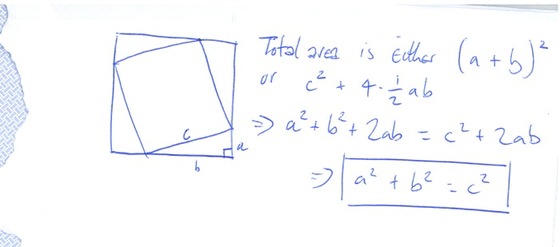
Hi! Here is a back-of-the-envelope derivation. It genuniely is: it's my pay slip, which arrived this morning. The geometry is pretty much the same as on the video. It's all about there being two ways to express the area of the large square -- you write down the Pythagoras theorum more-or-less immediately.
The text you are quoting:
Hi! Here is a back-of-the-envelope derivation. It genuniely is: it's my pay slip, which arrived this morning. The geometry is pretty much the same as on the video. It's all about there being two ways to express the area of the large square -- you write down the Pythagoras theorum more-or-less immediately.
hayes, Apr 7, 2010 @ 08:59
Your Reply: