
Hello. Someone gave us a clothes dryer and after using it for some time we realized that it has a french plug that's why we are having blown fuse from time to time. Someone recommended that we just have to change the plug to a swiss one. But after a year of using it the plug and the socket is slowly melting. What do we have to do? Do we have to buy a swiss dryer or is there any way that we could still use the machine. Thanks in advance for the help.
Forums in Geneva > Geneva > French plug

Only members can see names and photos
French plug
Mar 23, 2015 @ 14:34
The text you are quoting:
Hello. Someone gave us a clothes dryer and after using it for some time we realized that it has a french plug that's why we are having blown fuse from time to time. Someone recommended that we just have to change the plug to a swiss one. But after a year of using it the plug and the socket is slowly melting. What do we have to do? Do we have to buy a swiss dryer or is there any way that we could still use the machine. Thanks in advance for the help.
heavenscent700 dMar 23, 2015 @ 14:34
Your Reply:



Only members can see names and photos
Re: French plug
Post 1
Mar 23, 2015 @ 14:39
Only members can see names and photos
Re: French plug
Post 2
Apr 4, 2015 @ 18:50
So you managed to cram a French plug into a Swiss outlet with the only result of a blown fuse from time to time? You were lucky.
If the plug/socket is melting, it looks like the appliance is drawing too much power from the line. The fuse should prevent it from overloading, but either your socket was faulty or you borked it with your creative inter-standard plugging.
I would recommend asking an electrician that will fix the plug and the socket. If the dryer still works there's no need to change it.
The text you are quoting:
So you managed to cram a French plug into a Swiss outlet with the only result of a blown fuse from time to time? You were lucky.
If the plug/socket is melting, it looks like the appliance is drawing too much power from the line. The fuse should prevent it from overloading, but either your socket was faulty or you borked it with your creative inter-standard plugging.
I would recommend asking an electrician that will fix the plug and the socket. If the dryer still works there's no need to change it.
TheOmegaMan, Apr 4, 2015 @ 18:50
Your Reply:
Only members can see names and photos
Re: French plug
Post 3
Apr 4, 2015 @ 21:31
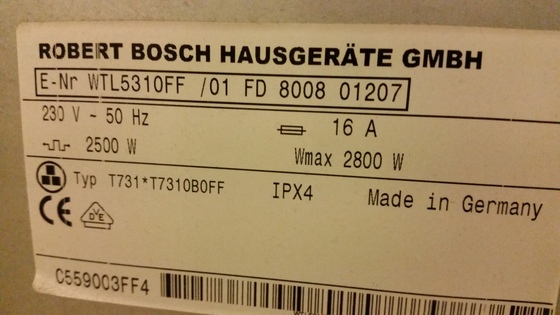
The device is designed for 16 amps circuits. (It uses 13 amps max)
I think Swiss normal sockets are rated for 10 amps. (See http://en.wikipedia.org/wiki/AC_power_plugs_and_sockets#10.C2.A0A_rated_devices) So It's not surprising that the fuses are blowing, and that the sockets are melting.
Unless you find a way of running it on lower power, I definately think there can be a risk in using it.
As mentioned above, the best would be to get the advice of an expert. (Electrician)
The text you are quoting:
The device is designed for 16 amps circuits. (It uses 13 amps max)
I think Swiss normal sockets are rated for 10 amps. (See http://en.wikipedia.org/wiki/AC_power_plugs_and_sockets#10.C2.A0A_rated_devices) So It's not surprising that the fuses are blowing, and that the sockets are melting.
Unless you find a way of running it on lower power, I definately think there can be a risk in using it.
As mentioned above, the best would be to get the advice of an expert. (Electrician)
tawb, Apr 4, 2015 @ 21:31
Your Reply:
Only members can see names and photos
Re: French plug
Post 4
Apr 4, 2015 @ 21:53
Your problem is not the plug. You are probably using a two prongue plug, without a third, ground plug. Not a good idea, but that is not the problem. There is a reason why you can use a French/EU plug on a swiss outlet with just a simple adapter, without needing a transformer.
You problem is that your dryer uses 2,500 watts of power. That's a lot of juice! The reason you blew fuses only some times, was that the load you put on that particular circuit depended on what other appliances you were using simultaneously.
When someone gave you the dryer, how did you chose where to plug it in? When apartments and houses are built some circuits are set to be able to carry a higher load, and the number of outlets in those circuits are limited. Buying a swiss dryer is not going to solve the problem if you plug it on the same outlet you have been using.
Unless you can figure out the circuits in your place, get an electrician to advice you. It will be safer and less costly in the long run. Changing a blown fuse is just an annoyance, a fire is very dangerous.
And do make sure that the plug fits well in the socket and all the wiring at both ends is tight. As mentioned in the post above, a lose connection can cause heating and make the problem worse. You can easily get an adaptor, by the way or replace the plug with a swiss one.
The text you are quoting:
Your problem is not the plug. You are probably using a two prongue plug, without a third, ground plug. Not a good idea, but that is not the problem. There is a reason why you can use a French/EU plug on a swiss outlet with just a simple adapter, without needing a transformer.
You problem is that your dryer uses 2,500 watts of power. That's a lot of juice! The reason you blew fuses only some times, was that the load you put on that particular circuit depended on what other appliances you were using simultaneously.
When someone gave you the dryer, how did you chose where to plug it in? When apartments and houses are built some circuits are set to be able to carry a higher load, and the number of outlets in those circuits are limited. Buying a swiss dryer is not going to solve the problem if you plug it on the same outlet you have been using.
Unless you can figure out the circuits in your place, get an electrician to advice you. It will be safer and less costly in the long run. Changing a blown fuse is just an annoyance, a fire is very dangerous.
And do make sure that the plug fits well in the socket and all the wiring at both ends is tight. As mentioned in the post above, a lose connection can cause heating and make the problem worse. You can easily get an adaptor, by the way or replace the plug with a swiss one.
JR M, Apr 4, 2015 @ 21:53
Your Reply:
Only members can see names and photos
Re: French plug
Post 5
Apr 4, 2015 @ 22:10
If you want to find the relationship between what I wrote with what tawb just posted, it works like this:
Voltage is a measure of electric potential or electric energy. Amperage is a measure of the current, that is the amount of energy flowing through. The power is measured in watts, and is a function of the current (I) and voltage (V). P(W) = V(V)× I(A)
To put it simply, a large current of electrons will provide a lot more power than a small current.
So, your dryer requires 2,500-2,800 watts of power. In a 230 volt outlet, it will draw a current of around 12 amperes (230 volts x 12 amperes = 2760 watts). That is why it indicates you should use outlets with the capacity for 16 amperes. It assumes there will be other devices operating in the circuit.
The text you are quoting:
If you want to find the relationship between what I wrote with what tawb just posted, it works like this:
Voltage is a measure of electric potential or electric energy. Amperage is a measure of the current, that is the amount of energy flowing through. The power is measured in watts, and is a function of the current (I) and voltage (V). P(W) = V(V)× I(A)
To put it simply, a large current of electrons will provide a lot more power than a small current.
So, your dryer requires 2,500-2,800 watts of power. In a 230 volt outlet, it will draw a current of around 12 amperes (230 volts x 12 amperes = 2760 watts). That is why it indicates you should use outlets with the capacity for 16 amperes. It assumes there will be other devices operating in the circuit.
JR M, Apr 4, 2015 @ 22:10
Your Reply:
Only members can see names and photos
Re: French plug
Post 6
Apr 5, 2015 @ 14:58
JR M,
2500 W is quite a normal power for a dryer, isn't it? I mean, it's not a eco-dryer, but it's not an abnormally high consumption neither.
Of course, if the wiring in the OP's house is obsolete and cannot support the power, that's the problem.
The text you are quoting:
JR M,
2500 W is quite a normal power for a dryer, isn't it? I mean, it's not a eco-dryer, but it's not an abnormally high consumption neither.
Of course, if the wiring in the OP's house is obsolete and cannot support the power, that's the problem.
TheOmegaMan, Apr 5, 2015 @ 14:58
Your Reply:
Only members can see names and photos
Re: French plug
Post 7
Apr 9, 2015 @ 12:36
Yes, you are right. That wattage is normal for a dryer.
But to get an idea of what it means in the general context of the currents that domestic electrical circuits have to bear, think of other appliances. Your light bulbs use 60 watts. A very bright bulb requires 100 watts.
So, a dryer requiring 2500-2800 watts, all at once, with the voltage remaining constant at 220-230 volts, will require a much larger current (around 12-13 Amperes). A circuit can withstand that if it is built to do so, with larger diameter wires, greater insultation on the cables, and fewer appliances plugged into it.
Houses and apartments are built with some circuits and outlets placed where there will be higher power appliances that draw larger currents. Compare the diameter of the wires on a dryer or refrigerator with that of a simple lamp to get a sense.
The text you are quoting:
Yes, you are right. That wattage is normal for a dryer.
But to get an idea of what it means in the general context of the currents that domestic electrical circuits have to bear, think of other appliances. Your light bulbs use 60 watts. A very bright bulb requires 100 watts.
So, a dryer requiring 2500-2800 watts, all at once, with the voltage remaining constant at 220-230 volts, will require a much larger current (around 12-13 Amperes). A circuit can withstand that if it is built to do so, with larger diameter wires, greater insultation on the cables, and fewer appliances plugged into it.
Houses and apartments are built with some circuits and outlets placed where there will be higher power appliances that draw larger currents. Compare the diameter of the wires on a dryer or refrigerator with that of a simple lamp to get a sense.
JR M, Apr 9, 2015 @ 12:36
Your Reply: